
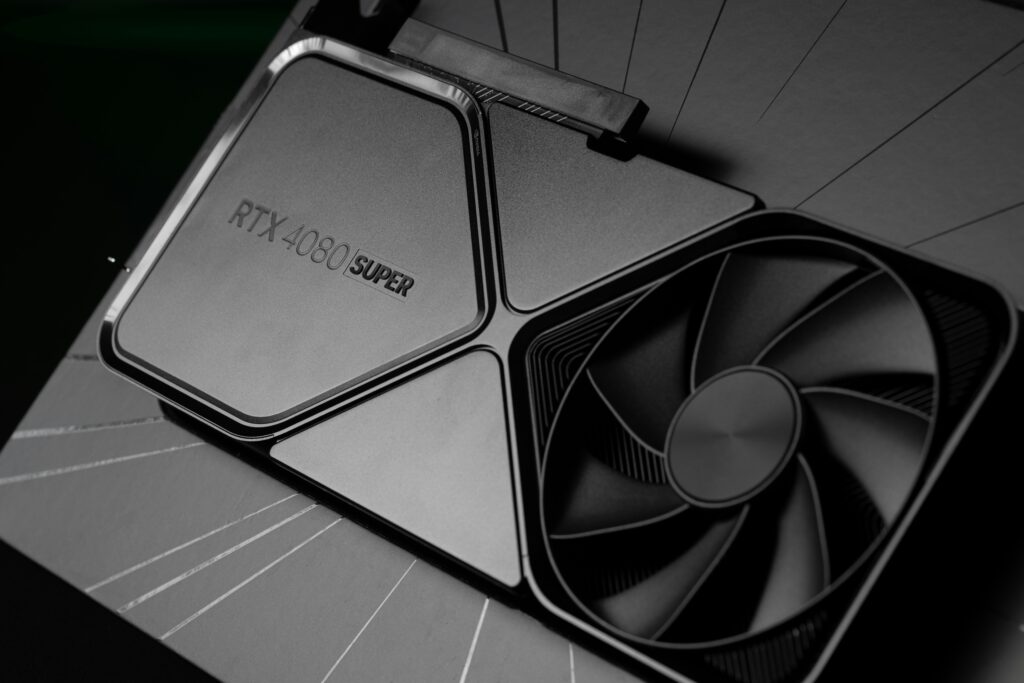
When we see names like Ampere, Lovelace, Hopper or Blackwell on graphics cards or AI accelerators, we might think they’re just marketing labels, the name of a scientific star meant to grab attention. But behind each of these generations lies a story: a major technological leap and a tribute to some of the brightest minds in science.
NVIDIA has followed the tradition of naming its GPU architectures after scientists, mathematicians and computing pioneers. Each name reflects not only a technical breakthrough but also symbolic inspiration:
Ampère for electromagnetism, Lovelace for programming, Hopper for machine language and Blackwell for statistics and probability.
Let’s look at what distinguishes each NVIDIA generation and what these names represent.
Ampere: The Leap Toward Modern AI
Released in 2020, the Ampere architecture marked a new era. Its name comes from André-Marie Ampère (1775–1836), a French physicist and mathematician considered one of the fathers of electromagnetism.
This generation introduced more powerful Tensor and RT cores, improving performance in both artificial intelligence and graphics. Simply put, Ampere enabled GPUs to train complex AI models while delivering realistic lighting through ray tracing.
It was the generation that cemented NVIDIA not just as a gaming company but also as a key player in the AI world.
Lovelace: Efficiency, Neural Graphics, and the Bridge to Creative AI
Two years later, in 2022, came Ada Lovelace, named in honor of the English mathematician Ada Lovelace (1815–1852), considered the first computer programmer in history.
The Lovelace architecture brought a more advanced manufacturing node, higher transistor density, and improved energy efficiency.
It also introduced third-generation RT Cores and fourth-generation Tensor Cores, boosting performance in tasks such as ray tracing and AI-generated graphics.
In practical terms: Lovelace doubled the performance per watt compared to Ampere and brought graphics and AI closer than ever. It powered the RTX 40 series, used by both gamers and content creators.
Hopper: The Silent Engine of the AI Revolution
Released in 2022, almost in parallel with Lovelace, Hopper focused on a different front: data centers and large-scale training of artificial intelligence models.
Its name honors Grace Hopper (1906–1992), a pioneer of computer science, U.S. Navy rear admiral, and creator of the first compiler, the software that translates human instructions into machine language.
The Hopper architecture introduced the innovative Transformer Engines, designed specifically to accelerate the training of language models and deep neural networks.
In other words, while Lovelace shone on the desks of gamers and designers, Hopper was the hidden brain behind the rise of generative AI. Its flagship GPU, the H100, is now one of the most widely used in data centers that train models like ChatGPT.
Hopper represents NVIDIA’s transition to a more AI-centered focus, laying the foundations for what would come next.
Blackwell: The Future of Large-Scale AI
In 2024, NVIDIA introduced Blackwell, its next-generation GPUs designed specifically for generative AI and hyperscale computing.
The name pays tribute to David Harold Blackwell (1919–2010), an American mathematician and statistician specializing in probability and game theory, and the first African American academic elected to the U.S. National Academy of Sciences.
Blackwell continues Hopper’s legacy but pushes performance and efficiency to new levels. It is designed to handle models with trillions of parameters, reduce energy consumption in data centers, and accelerate both training and inference.
Simply put: Blackwell is the generation built for the future of AI, rather than for home users. Its goal is to make possible what seemed impossible just a few years ago: massive models, faster and more sustainable.
What’s the Connection Between the Name and the Technology?
Although the names might seem like coincidences, they actually hold symbolic meaning related to the breakthroughs they represent:
- Ampère was a physicist of electromagnetism → GPUs with more power and parallel processing.
- Lovelace was the first programmer → a generation that unites graphics and artificial intelligence.
- Hopper created the compiler → a generation that translates human language into machine operations (generative AI).
- Blackwell was a statistician → a generation centered on large-scale probabilistic learning.
It’s not a literal relationship. It’s a well-chosen metaphor: each name encapsulates the type of intelligence or innovation that defines its generation.
Leverage state-of-the-art NVIDIA GPU infrastructure
Each NVIDIA architecture—Ampere, Lovelace, Hopper, and now Blackwell—represents a leap in capability and a new chapter in AI computing. To take advantage of these advances, you need reliable access to modern GPU infrastructure.
Massed Compute delivers exactly that, offering enterprise-grade NVIDIA cloud GPUs with hands-on engineering support for workloads of any scale. Sign up and check out our marketplace today!
